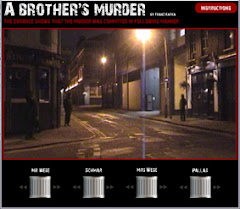
- Taz finished the storyboard.
- The possible combinations are infinite; here, we list 12 types first.
- The rest rely on coding to allow VURPs' to explore.


Showing posts with label 1. Storyboarding and Conceptualisation. Show all posts
Showing posts with label 1. Storyboarding and Conceptualisation. Show all posts
2008-01-19
Storyboard


2008-01-15
To play with Ambiguity? (after tutorial with Sandra)
We explained to Sandra our first-stage idea. Since it's still very rough, we need to figure out more details to make our concept complete.
Snadra suggested, if we want to play with Ambiguity, we should make research first about the definition. Besides, although we want to challenge, we should keep in mind about the following:
- does it make sense?
- is it motivated?
- what are you trying to do?
- what do you want to acchieve?
- challenge doesn't mean just do something new. "Motivation is key!"
- risk: may loose the Kafka's story
After the tutorial, we sit down have a discussion again and make a list about all the ambiguity in this story.
1. Motivation for the murder2. The relationship between Pallas and Schmar
3. The relationship between Julia and Schmar
4. Scrutiny: - Why was Pallas satisfied and why couldn't Schmar reach a conclusion?
5. Are Schmar and Wese brothers?
6. Who is Julia?
7. Why did Pallas not stop the murder?
8. Is Schmar satisfied with the result?
9. Is Schmar arrested by the policeman?
We also made research about ambiguity:
- Emphasise Ambiguity - 'Ambiguity as a resource for design' http://machen.mrl.nott.ac.uk/var/uploads/2002-gaver-0.pdf
- Ambiguity definition http://www.google.co.uk/search?hl=en&rlz=1B3GGGL_enGB232GB238&defl=en&q=define:ambiguity&sa=X&oi=glossary_definition&ct=title
- Ambiguity as a Conceptual Framework for Design - Michelle Dalmau http://mcs.open.ac.uk/yr258/amb_frame/
Concept decided and production planning
Concept decided:
Once the concept decided, we have to make storyboard with possible combinations first, then we can process video shooting. (waiting...)
- an interactive movie, not a game.
- seperate each characters' timeline as sliders/scrolls on interface
- users can control and move forward or backward to see what happen and different endings
- we need to find the possible combinations (maybe thousands...)
- all of us know the coding is difficult but we all agree it's very challenging and excited to have a try
- although the puzzle game idea is also very interesting, considering it's lower interactivity, or we can say, it may be the safe alternative for our project. But may difficult to trigger VURPs' interest and motivation
- i prefer to challeging play with narrative elements: character and time
Once the concept decided, we have to make storyboard with possible combinations first, then we can process video shooting. (waiting...)
2008-01-14
1st meeting with teammate - share ideas
We shared with each other how we deconstruct and analyze the text.
- the text-order and the story-order are the same because the murder was narrated chronologically.
- the non-linear model this text represents is multiple storyline
I think the text can be divided apparently by certain time segment. At each same time segment, there are several events consisted by “different characters in each location or overlapped location”.
For example: The first time segment is before the murder happened (around 9 o’clock). The murderer, Schmar is waiting in the corner and struck his weapon; the witness, Pallas is watching from the window; the victim’s wife, Mrs Wese peers out to wait for his husband back home; the victim, Mr Wese is working in office. We can discover, at the same time segment, these events (4 characters in 4 locations) happened synchronously.
Then, the door bell ring started the second time point and the third or forth followed.
In this text, I think it can be separated by 5 major time segments, which are: 9 o’clock before murder, the door bell rings out, the murder, after the murder and the end. Within each time segment, it embedded different character’s storyline based on locations.
 (personal)
.jpg) (Team Diagram)
(Team Diagram)
- the text-order and the story-order are the same because the murder was narrated chronologically.
- the non-linear model this text represents is multiple storyline
I think the text can be divided apparently by certain time segment. At each same time segment, there are several events consisted by “different characters in each location or overlapped location”.
For example: The first time segment is before the murder happened (around 9 o’clock). The murderer, Schmar is waiting in the corner and struck his weapon; the witness, Pallas is watching from the window; the victim’s wife, Mrs Wese peers out to wait for his husband back home; the victim, Mr Wese is working in office. We can discover, at the same time segment, these events (4 characters in 4 locations) happened synchronously.
Then, the door bell ring started the second time point and the third or forth followed.
In this text, I think it can be separated by 5 major time segments, which are: 9 o’clock before murder, the door bell rings out, the murder, after the murder and the end. Within each time segment, it embedded different character’s storyline based on locations.
Comparing my personal text-order / story-order and diagram with group’s, I found some aspects are slightly different in the following issues:
Issue 1. Text-order and story-order list (my revised list has 11 sentences, my group is 17)
I combined details in one sentence because I thought these tiny points happened at the same time segment and no big difference even if we separate in 2 or 3 sentences. For ex., my first sentence is Schmar brings a knife, strucks the knife and waits the victim by the corner of the street; but my group separated them to be 2 sentences (See The personal and team text-order and story-order).
 (personal)
http://0708maimmintnarc.blogspot.com/2008/01/final-story-order.html (Links to team story-order)
Issue 2. Multiple Storyline Diagram diversities I separated the timeline by 5 segments. However, my group’s split the timeline by more exact events and based on about 9pm or after 9pm (See Team diagram). Another interesting finding is, in my original diagram included 6th character Julia. Yet, my teammates searched 2 more versions of Czech and German translation text, we found Julia is Mrs Wese. In German version, there is one sentence wrote, “Julia is waiting in vain.” The more research we made, the more we understand Kafka’s original story and having ideas in analysis the story.
F. Kafka: Bratrovrazda - Czech translation http://ld.johanesville.net/kafka-07-povidky?page=15
F. Kafka: Ein Brudenmord - German original http://www.textlog.de/32071.html
.jpg) (Team Diagram)
(Team Diagram)
2008-01-13
Deconstruction Diagram: Non-Linear model (multiple storyline)
After drawing the diagram, I found the Timeline, Characters and locations should be more detailed as below.
The motivation of murder is interesting, what I think is, the motivation can be developed to the main idea to design an interactive narrative game or movie. The VURP can be the detective and then inference the story by choosing roles.
.jpg)
The motivation of murder is interesting, what I think is, the motivation can be developed to the main idea to design an interactive narrative game or movie. The VURP can be the detective and then inference the story by choosing roles.
.jpg)
2008-01-12
Deconstruction of the short story from F. Kafka- A Brother's murder
Text B: A Brother’s Murder (from F. Kafka)
After reading the text, I found the text-order and story order are almost the same. The story is narrated by a narrator (P.O.V.) followed the timeline of murder/event. Only one order (no. 2), I think it's a little bit different. By the text order, the writer uses question sentences to tell reader, Pallas is the witness and during Time 1 and Time 2, he was waiting and watching from his window. However, if we follow the story order, it should be, "Wese has been killed by Schmar --> and then, Pallas witnessed all the process".
Another interesting point is, readers are not sure Julia's role. All the clue is from Schmar shrieked to Wese, "Wese! You will never see Julia again!", and maybe writer leaves the imagination for readers to guess, trigger readers' curiosity and then every reader will have their own story in their brain. For example, Julia maybe Mrs Wese's name, something happend during the 3 people which cause the murder motivation. Or Julia maybe the 5th character in this story, and there is another event.
According to the story, simple and first-satge analysis could be listed as followed:
- Characters:
C1: Schmar, the murder
C2: Pallas, the witness
C3: Wese, the victim and a industrious night worker
C4: Mrs Wese, the victim’s wife
C5: Julia (? maybe Mrs Wese’s name, maybe someone which was known by the murderer and victim in common.)
- Timeline:
Time 1: before the murder event happened
Time 2: the murder happened
Time 3: after - Location:
L1: the corner of the street where Wese worked.
L2: Pallas’s home
L3: Wese’s home, only 5 houses farther along on the opposite of the street. - Text-order:
1. In one night with clear moonlight, Schmar, the murder, brought a knife and waited the victim by the corner of the street.
2. Meantime, Pallas, the private citizen, witnessed all the murder from his window.
3. The victim’s wife, Mrs Wese waited her husband at home which is only 5 houses farther along on the opposite of the street.
4. There rang out the sound of the door bell and Mr Wese, the industrious night worker, walked out the building and paused by the corner.
5. Wese was stopped and killed by Schmar.
6. Pallas shut to Schmar ‘he saw it at all’ and they scrutinized each other.
7. Mrs Wese came rushing up with shock and collapsed on top of Wese.
8. Schmar, the murder was led away by the policeman. - Story-order:
1. In one night with clear moonlight, Schmar, the murder, brought a knife and waited the victim by the corner of the street.
2. Meantime, Pallas, the private citizen, seemed that he knew the murderer, stood and watched from his window to wait for the murder happened.
3. The victim’s wife, Mrs Wese waited her husband at home which is only 5 houses farther along on the opposite of the street.
4. There rang out the sound of the door bell and Mr Wese, the industrious night worker, walked out the building and paused by the corner.
5. Wese was stopped and killed by Schmar.
6. Pallas witnessed all the murder, shut to Schmar ‘he saw it at all’ and they scrutinized each other.
7. Mrs Wese came rushing up with shock and collapsed on top of Wese.
8. Schmar, the murder was led away by the policeman.
Subscribe to:
Posts (Atom)